Skip to content

Decision-support tool Timeline

Pre-industrial prologue, then 1824 → 2026 · world / Canada / Quebec

Two centuries of ecological debate

This timeline connects four things usually treated separately: what we know, what we institutionalize, who holds the power to act or to block, and how we talk about it. It covers two centuries of debate, preceded by a prologue reaching back well before climate science.

Thesis Ecological constraint passes quickly when almost no vested interest is at stake (CFCs and the ozone layer). It eventually passes, despite industry resistance, when the public health stakes grow too heavy (lead in petrol, acid rain). It stalls when the threatened interest is central. What could be regulated has been; the rest is waiting. This is an interpretation, and the timeline supplies what is needed to contradict it.

Climate holds a central place here, but as one limit among nine: habitability also depends on the living world, fresh water, soils, the nitrogen and phosphorus cycles, the oceans and chemical pollution. It is written from Quebec: every period includes a federal assessment and a Quebec one.

What does each period contain?
BlockThe question it answersHow to spot it
🔬KnowledgeWhat becomes possible to know, to measure, to name?First column of the period table
🏛️InstitutionsWhich treaties, laws, bodies and instruments are created?Second column
⚙️Balance of powerWhich material interests make action possible or costly?Third column
🗣️Dominant discourseHow is acting, or waiting, justified?Fourth column, cream background
📍MilestonesWhich events shifted the public debate?Dated list, dot colour by scale
👥ActorsWho pushes, who hesitates, who holds back?Three columns ▲ drivers · ◆ pivots · ▼ brakes
🍁⚜️Canada and QuebecWhat moved forward, what moved back?Coloured boxes, ▲ and ▼ lists
Perspectives
table blocks
Scales
milestones and boxes
10 periods shown
Status of the elements, and reading key

A timeline easily freezes what is merely announced into something achieved, and what is merely a reading into a fact. Two keys make the difference visible.

Factual status of the elements

  • Achieved : event occurred, law passed, measure in force.
  • Announced : political agreement, draft regulation, strategy or negotiation under way, with no legal effect to date.
  • Projected : target, revenue or capacity promised for a future date.
  • Disputed : serious and open factual, legal or historiographical controversy.

On milestones, the colour of the dot indicates the scale and its shape indicates the status. In the Canada and Quebec assessments, the status is spelled out at the end of the line.

Nature of the statements

  • Fact : dated and traceable to a primary or institutional source.
  • Interpretation : causal mechanism proposed by the timeline, flagged by the label Interpretation on period theses, on the “balance of power” and “dominant discourse” blocks, and at the head of the analysis sections. Anything without that label is meant to be descriptive.
  • Assessment : the ▲ advance and ▼ setback labels, in the Canada and Quebec assessments, judge the consistency between a decision and the documented biophysical thresholds, never the intentions of the people involved.
  • Contestation : where serious readings diverge, the timeline flags this with the “disputed” status rather than settling the matter.
Prologue · before 1824

Before climate science: local limits, collapses and the birth of the idea of sustainability

InterpretationNo society has been spontaneously ecological. What limited destruction was most often the technical power available; what sometimes regulated it were institutions, never mere virtues.
🌍 World 🍁 Canada ⚜️ Quebec

Knowledge

🧭 Systemic🌿 Living world & territories🌍 World

Ecological knowledge exists, but it is local, empirical and handed down: harvest calendars, controlled burns, crop rotation, reading animal cycles. It allows fine management of a known territory, not a planetary understanding.

The first observations of degradation are ancient: Plato describes the erosion of Attica's soils, Pliny and Theophrastus link deforestation with springs running dry. These are observations, not a theory of thresholds.

Institutions

🌿 Living world & territories⚖️ Law & institutions🌍 World

Regulations exist: hunting taboos, use rights, collectively managed commons, royal forest ordinances. They work when the resource is visible, the community stable and cheats identifiable, the conditions Elinor Ostrom would formalize three centuries later.

They fail when the resource becomes a tradable export asset, when users no longer know one another, or when a central power imposes its own calculation.

Balance of power

🧩 Interpretation🌿 Living world & territories💰 Economy & finance🌍 World🍁 Canada

Agriculture produces surpluses, surpluses produce elites, and elites produce empires that draw beyond the territory they inhabit: ship timber, metals, slaves, sugar. Degradation becomes exportable, and therefore invisible to those who decide.

From the 16th century onward, chartered companies and plantations set up the first genuinely globalized extraction system.

Dominant discourse

🧩 Interpretation🧭 Systemic🗣️ Discourse & opinion🌍 World

domination Religious and legal readings that make nature a domain entrusted to human use.

terra nullius A territory not cultivated “in the European manner” is declared vacant: dispossession is justified by a theory of improvement.

moral economy In the commons, use is a bounded collective right, and its enclosure is perceived as an injustice.

first warning Evelyn denounces London's air (1661); Malthus raises the question of demographic limits (1798).

Moment and placeWhat happensEcological effectWhat it teaches
~50,000 – 10,000 BCE
Australia, the Americas, Madagascar, New Zealand
Human expansion and specialized big-game hunting. Disappearance of most large mammals: mammoths, mastodons, giant sloths, giant beaver, moa. Climate plays a part, but human arrival coincides almost everywhere with extinction. Very small societies, without machines or markets, were already able to wipe out entire lineages.
~2400 BCE
Mesopotamia
Intensive irrigation without sufficient drainage. Progressive soil salinization; wheat gives way to more tolerant barley, then yields collapse. A technical success can destroy its own foundation within a few centuries.
~400 BCE – 400 CE
Mediterranean basin and Roman Empire
Deforestation for shipping, metalworking, baths and heating; extensive grazing; silver and lead mines. Soil erosion and the disappearance of entire forests; lead pollution from Roman mines is measurable in Greenland ice, the first industrial signature at hemispheric scale. An empire can lastingly degrade its material base without having any instrument to measure it.
~1300 – 1450
New Zealand, the Pacific
Colonization of islands with no predators. Extinction of the moa within a few generations; complete transformation of island ecosystems. The more isolated the environment, the faster and more irreversible the collapse.
1600 – 1750
Edo Japan, the Alps, Scandinavia
Timber shortage, then reforestation policies, quotas and strict use rights. Effective restoration of Japan's forest cover; lasting maintenance of Alpine communal forests. Sustainability is an institution, produced by a crisis and by an authority able to compel, not a cultural disposition.
1661 – 1713
England, France, Saxony
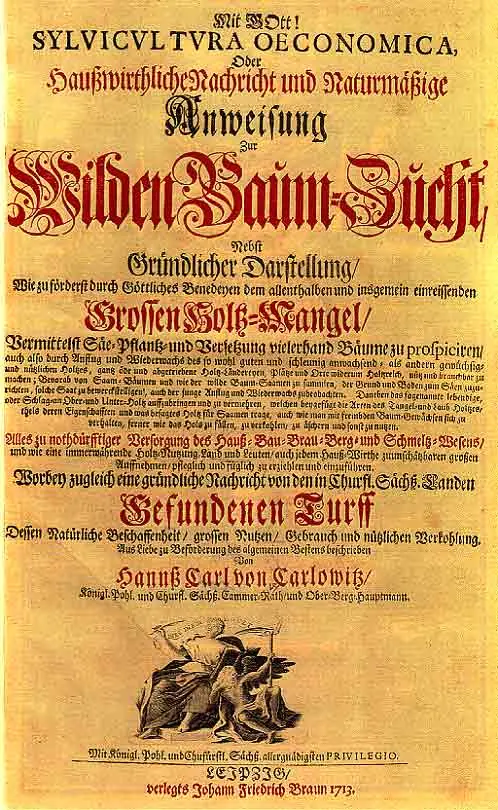
Fumifugium and Sylva by Evelyn, Colbert's forest ordinance (1669), Sylvicultura oeconomica by Carlowitz (1713). Regulation of felling, planting, calculation of renewal. The word “sustainability” is born of a military and mining supply problem, not of a concern for nature.
1670 – 1820
St. Lawrence valley, Great Lakes basin
Fur trade for the European felt hat market; then white pine felling for the British navy. Collapse of beaver populations, disappearance of their dams and drying of wetlands; first massive cuts in the Ottawa valley. The first North American resource to be exhausted was exhausted by a global market, two centuries before industrialization.
1815 – 1816
Indonesia, then the Northern Hemisphere
Eruption of Tambora, the most powerful of the historical era. “Year without a summer”: June frosts in Lower Canada and New England, lost harvests, famine and riots in Europe. Climate is recognized as a political and social variable, eight years before Fourier states the greenhouse effect.

What is settled, and what remains disputed

  1. Debate 1🌍 Megafauna: climate or humans? Research today attributes varying shares to both factors depending on the region, with a human role all the clearer where colonization is late and the island isolated. Perspectives: systemic, living world. Status: disputed.
  2. Debate 2🌍 The “ecocide” of Rapa Nui. The popularized account of a society that destroyed itself by cutting down its trees is contested: introduced rats, the slave trade and colonial epidemics explain much of the demographic collapse. Above all, the case illustrates how a collapse narrative can serve opposing political morals. Perspectives: systemic, discourse. Status: disputed.
  3. Debate 3🌍 What exactly collapses? In Goliath's Curse (2025), Luke Kemp analyses more than three hundred collapses and argues that it is not “civilizations” that fall but “Goliaths”: extended, centralized and highly unequal states, weakened by their elites' capture of resources. He adds that collapse is often partial, and that it has sometimes improved the lot of ordinary people. The thesis is debated: it is criticized for reducing multiple causation to a single factor, but it usefully shifts the question: vulnerability owes as much to the structure of power as to the environment. Perspectives: systemic, economy. Status: disputed.
  4. Marker🌍 The limiting factor was long the power available. A stone axe, an ox-drawn plough and a sailing fleet cap the damage. Coal, then oil, lift that cap: the same willingness to extract then produces planetary effects. Perspectives: systemic, economy. Status: disputed.
  5. Marker⚜️ Societies with a long horizon did genuinely exist. Controlled burns, seasonal fishing quotas, rules for sharing hunting territory among the nations of the Northeast: social arrangements, handed down and collectively enforced, that maintained balances for centuries, and that the fur trade disorganized within a few decades. Perspectives: living world, mobilization, law & institutions. Status: disputed.

▲ Regulators

  • Communities managing commons: forests, pastures, fisheries
  • Indigenous nations: burns, seasonal taboos, territorial sharing
  • State foresters and agronomists of the 17th–18th century

◆ Ambivalent actors

  • Mercantilist states: they protect the forest for the navy, not for the forest
  • Religious orders: long-term managers and legitimizers of domination
  • Cities: first to regulate smoke and waste, first to produce them in bulk

▼ Resource predators

  • Extractive empires and plantation economies
  • Chartered companies: fur, spices, sugar
  • Enclosure movements stripping communities of their commons

🍁 Canada

Long-term practices

  • Indigenous territorial management systems: rotation of hunting grounds, cultural fire, seasonal harvesting rules.
  • Three Sisters agriculture and fisheries management in the St. Lawrence and Great Lakes valleys.

Destruction and dispossession

  • Fur trade: collapse of beaver populations, forced reorganization of Indigenous economies around a European market.
  • Colonial epidemics and territorial dispossession, which also destroy the ecological institutions already in place.

⚜️ Quebec

Long-term practices

  • Innu, Atikamekw, Wendat, Mohawk and Algonquin knowledge of the cycles of caribou, eel and beaver.
  • Seigneurial system: riverside division into rangs giving every plot access to water and wood.

Destruction and dispossession

  • Continuous clearing of the St. Lawrence valley; the beaver disappears from settled regions before the end of the 18th century.
  • After 1806: intensive white pine felling for the British navy, the first large-scale export industry.
  • 1816: summer frosts and poor harvests in Lower Canada, the consequence of an eruption at the other end of the world.

Reading and reference points

L. Kemp, Goliath's Curse (2025) · J. Diamond, Collapse (2005) and its critique by T. Hunt and C. Lipo, The Statues That Walked (2011) · C. Totman, The Green Archipelago (1989) · E. Ostrom, Governing the Commons (1990) · G. Parker, Global Crisis (2013) · H. C. von Carlowitz, Sylvicultura oeconomica (1713) · T. Malthus, An Essay on the Principle of Population (1798).
1824 – 1949

The industrial era: mass damage, hygiene and conservation

InterpretationIndustry produces, at one and the same time, large-scale damage, the statistics that make it visible, and the economic doctrine that declares it beside the point.

🌍 World 🍁 Canada ⚜️ Quebec

Knowledge

🧭 Systemic🌡️ Climate & energy☣️ Pollution & health🌍 World

The physics of the greenhouse effect is established in stages: Fourier (1824), Eunice Foote and John Tyndall (1856-1859), Arrhenius (1896), who calculates the effect of a doubling of CO₂, then Callendar (1938), who already believes he can see warming in the records. Nobody sees a political issue in it.

Ecology takes shape as a science (the notion of ecosystem dates from 1935) while public hygiene invents health statistics: urban mortality becomes a measurable fact, and therefore a political one.

Institutions

🌿 Living world & territories⚖️ Law & institutions🌍 World🍁 Canada

Three logics coexist without speaking to one another: the conservation of exploitable resources, the preservation of remarkable landscapes in the form of parks, and urban sanitation .

The environment does not exist as an administrative domain: it is split among mines, forests, health, agriculture and public works. The IUCN, created in 1948, is the first international conservation body.

Balance of power

🧩 Interpretation☣️ Pollution & health💰 Economy & finance🌍 World

Coal then oil, railways, steel, synthetic chemistry: the power available changes order of magnitude. Colonial empires serve as reservoirs of raw materials and as outlets.

Damage is treated as externalities : local, technical, compensable. It is working-class districts and the colonies that absorb it.

Dominant discourse

🧩 Interpretation💰 Economy & finance🗣️ Discourse & opinion🌍 World

progress Nature is a stock to be developed; technology repairs what it damages.

conservation Rational, sustained use of resources, entrusted to state experts.

preservation Some landscapes are worth something in themselves, often at the cost of expelling their Indigenous inhabitants.

beside the point And an economic doctrine that settles the question before it is even asked: what is free does not enter the calculation.

Natural riches are inexhaustible, for without that we would not obtain them free of charge. Being neither multipliable nor exhaustible, they are not the object of economic science.
Jean-Baptiste Say, Cours complet d'économie politique pratique (1828-1829), a much-quoted formulation, sometimes wrongly attributed to the Traité of 1803

This sentence is not an anecdote: it grounds the exclusion of nature from the field of economics. What is free has no exchange value; what has no exchange value is not counted; what is not counted can be destroyed without anything appearing in the books. A century and a half later, this intuition will be formalized as the theory of substitutability, see the section “Substitute or preserve”.

Milestones that shifted the public debate

  1. 1864🌍 George Perkins Marsh, Man and Nature : the first systematic demonstration that societies lastingly transform their environment, and that civilizations have died of it. Perspectives: living world, discourse. Status: achieved.
  2. 1872🌍 Creation of Yellowstone, the world's first national park. The model will be exported everywhere, along with its blind spot: setting land aside presupposes excluding the Indigenous populations who lived there. Perspectives: living world, law & institutions. Status: achieved.
  3. 1896🌍 Arrhenius calculates the warming expected from a doubling of atmospheric CO₂. The result is received as a laboratory curiosity, even as a pleasant prospect for cold countries. Perspectives: climate, systemic. Status: achieved.
  4. 1909-1921🍁 Commission of Conservation of Canada: a federal expert body on forests, water, soils and public health, dissolved once it became inconvenient for the sectoral departments. Perspectives: law & institutions, economy. Status: achieved.
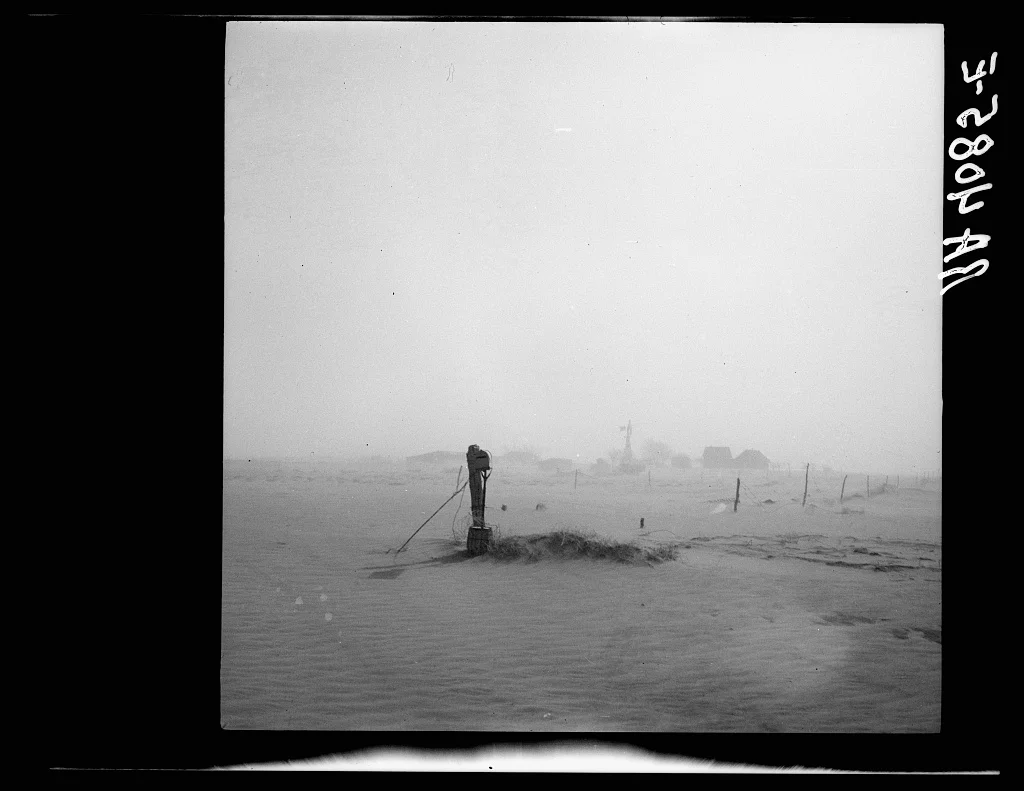
  5. 1930-1939🌍 Dust Bowl in North America: industrial ploughing of the Great Plains causes continental dust storms and drives hundreds of thousands of farmers into exile. The first public soil conservation policy is created in response to an ecological disaster. Perspectives: living world, economy. Status: achieved.
  6. 1948🌍 The deadly Donora smog and the creation of the IUCN: air pollution becomes countable in deaths, and conservation acquires an international organization. Perspectives: pollution, living world, law & institutions. Status: achieved.
  7. 1949🌍 Aldo Leopold formulates the land ethic; Fairfield Osborn publishes Our Plundered Planet. An ecological morality is written, still without a mass audience. Perspectives: discourse, living world. Status: achieved.

▲ Driving actors

  • Naturalists, geographers and scientific foresters
  • Hygienists and urban public health physicians
  • The first conservation associations and outdoor clubs
  • Soil agronomists after the Dust Bowl

◆ Pivot actors

  • Developmental states: polluters, regulators and resource owners all at once
  • Engineers and resource management agencies (dams, forests, mines)
  • Municipalities, on the front line of nuisances but dependent on their factories

▼ Braking actors

  • Extractive, steel and chemical industries
  • Manufacturers' associations and chambers of commerce
  • Mainstream political economy, which files nature outside its object

🍁 Canada

Advances

  • 1885: Rocky Mountains Park (Banff), Canada's first national park.
  • 1909-1921: Commission of Conservation, an early laboratory of federal environmental expertise.
  • First provincial forest laws and fire protection services.

Setbacks and blind spots

  • Collapse of the plains bison in the late 1870s, followed by famines that weigh heavily in the negotiation of the numbered treaties.
  • Parks created by excluding Indigenous nations from territories they occupied.
  • Industrial and mining pollution with no serious health oversight.

⚜️ Quebec

Advances

  • 1895: creation of the Laurentides and Mont-Tremblant parks, among the first in North America.
  • 1910: Commission des eaux courantes, the first public body for water management.

Setbacks and blind spots

  • Massive forest concessions to pulp and paper companies, with no ecological counterpart.
  • Asbestos at Thetford Mines and Asbestos mined without protection: the 1949 strike makes occupational disease public.
  • Industrial discharges and wastewater poured straight into the rivers and the St. Lawrence.

Founding reading

J.-B. Say, Cours complet d'économie politique pratique (1828-1829) · G. P. Marsh, Man and Nature (1864) · S. Arrhenius, on carbonic acid and ground temperature (1896) · G. Pinchot and J. Muir, the conservation / preservation quarrel (1897-1913) · F. Osborn, Our Plundered Planet (1948) · A. Leopold, A Sand County Almanac (1949).

1950 – 1971

The Great Acceleration

InterpretationAfter 1950, almost every curve turns upward at once: energy, fertilizer, plastics, cars, CO₂. In twenty years, ecology moves from a circle of naturalists to a mass political movement.

🌍 World 🍁 Canada ⚜️ Quebec

Knowledge

🧭 Systemic🌡️ Climate & energy☣️ Pollution & health🌍 World

This is the period Earth system researchers will name the Great Acceleration : some twenty socio-economic indicators (population, GDP, energy, fertilizer, dams, cars, telecommunications) and biophysical ones (CO₂, methane, reactive nitrogen, acidification, forest loss) tip almost simultaneously around 1950. It is this moment that will later be proposed as the marker of the Anthropocene.

1957: Revelle and Suess speak of a “large-scale geophysical experiment”. 1958: the Keeling curve measures CO₂ continuously and sees it rise year after year. Radioecology, born of nuclear fallout, learns to track a contaminant from the atmosphere all the way to children's bones.

Institutions

☣️ Pollution & health⚖️ Law & institutions🌍 World🍁 Canada

1963: the Partial Nuclear Test Ban Treaty is the first international agreement triggered by a pollutant measured in human bodies.

1969-1971: an unprecedented legislative wave. The United States passes the National Environmental Policy Act and creates the EPA; Canada gives itself a federal Department of the Environment (1971). The environment finally becomes a distinct administrative domain, twenty years after the start of the acceleration it is supposed to govern.

Balance of power

🧩 Interpretation🌡️ Climate & energy💰 Economy & finance🌍 World🍁 Canada

The post-war boom: cheap oil, the car, the suburb, household appliances, plastics, synthetic nitrogen fertilizer, the green revolution, civil nuclear power, large dams. Mass consumption becomes the acknowledged engine of prosperity and social peace.

Energy is so abundant and so cheap that the question of physical limits disappears from economic models: GDP growth imposes itself as the single indicator. In 1967 the first commercial oil sands plant starts up in Alberta; in 1971, Quebec announces the James Bay project.

Dominant discourse

🧩 Interpretation✊ Mobilization & justice🗣️ Discourse & opinion🌍 World

abundance “Better living through chemistry”, “atoms for peace”: technology promises comfort and security.

spaceship A reversal within a decade: the Earth becomes a closed system, with finite stocks and waste that comes back.

overpopulation A widely circulated demographic framing, which shifts responsibility towards the countries of the South and will be sharply contested.

commons “The Tragedy of the Commons” (1968) imposes the idea that shared use leads to plunder, a thesis Elinor Ostrom will refute empirically twenty years later.

Milestones that shifted the public debate

  1. 1954-1963🌍 Radioactive fallout from atmospheric testing: measuring strontium-90 in children's milk teeth turns a strategic debate into a health question and leads to the 1963 treaty. The first demonstration that an invisible pollutant can make nuclear powers back down. Perspectives: pollution, mobilization, law & institutions. Status: achieved.
  2. 1956🌍 Clean Air Act in Britain, four years after the London smog: the event manufactures the law, and the law works. Perspectives: pollution, law & institutions. Status: achieved.
  3. 1956🌍 Minamata disease (Japan): industrial mercury poisoning reveals long-term corporate responsibility. Perspectives: pollution, economy. Status: achieved.
  4. 1958🌍 Start of the Keeling curve: for the first time, the rise in atmospheric CO₂ is observed continuously rather than inferred. Perspectives: climate, systemic. Status: achieved.
  5. 1962🌍 Silent Spring by Rachel Carson: the first ecological bestseller, and the first coordinated industrial counter-offensive against a scientific author. Perspectives: pollution, discourse. Status: achieved.
  6. 1962-1970🍁 Mercury contamination of the English-Wabigoon River (Grassy Narrows, Ontario): a lasting environmental injustice against Anishinaabe communities, still unresolved sixty years later. Perspectives: pollution, mobilization. Status: achieved.
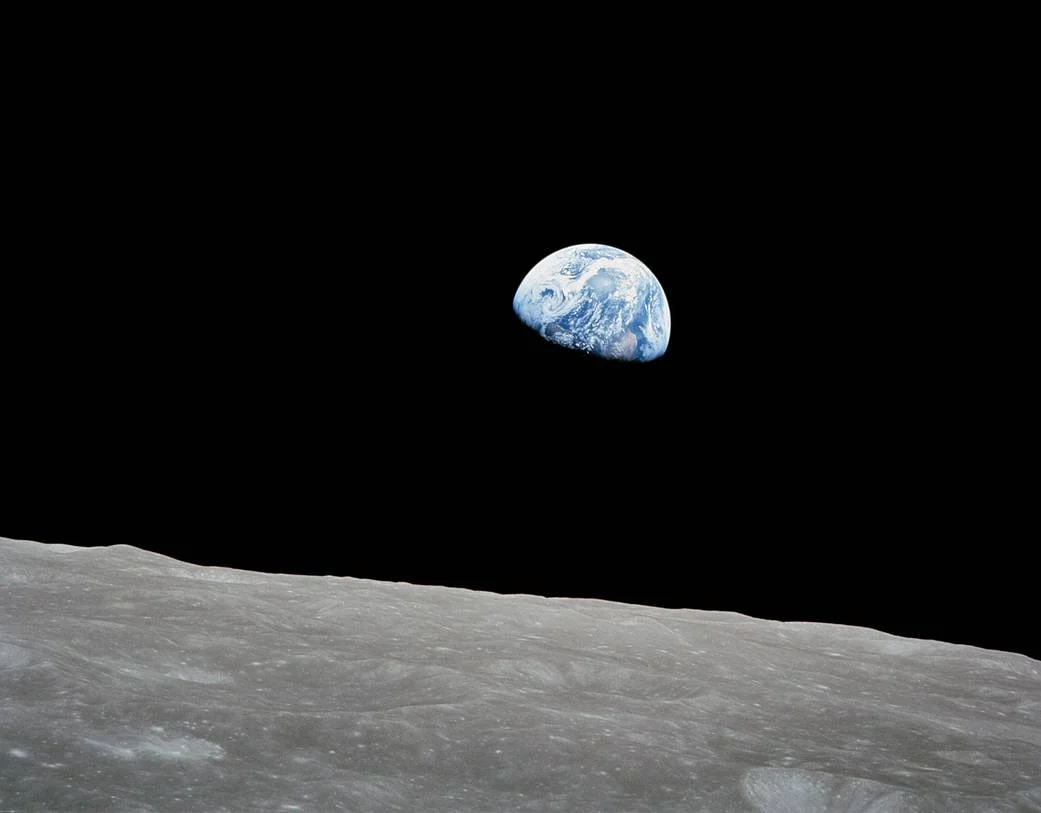
  7. 1968🌍 The Earthrise photograph (Apollo 8): the Earth becomes a finite, visible object. The same year sees “The Tragedy of the Commons” published and the Club of Rome founded. Perspectives: systemic, discourse. Status: achieved.
  8. 1969🌍 The Santa Barbara oil spill and the Cuyahoga River fire: founding images of the American regulatory wave. Perspectives: pollution, discourse. Status: achieved.
  9. 1970🌍 First Earth Day: 20 million participants in the United States; ecology becomes an electoral force. Perspectives: mobilization, discourse. Status: achieved.
  10. 1971🍁 Greenpeace founded in Vancouver, out of opposition to nuclear testing in Alaska. Perspectives: mobilization. Status: achieved.
  11. 1971⚜️ The James Bay project is announced without consulting the Cree and the Inuit. The court challenge that follows will lead to the 1975 Agreement. Perspectives: economy, mobilization, living world. Status: achieved.

▲ Driving actors

  • Rachel Carson and scientists who became public authors
  • Researchers on radioactive fallout, who invent health alerts grounded in measurement
  • Citizen committees, the counterculture, the anti-nuclear movement
  • Greenpeace and the first direct-action organizations

◆ Pivot actors

  • Space and defence agencies: they fund Earth system science for other reasons
  • Developmental states, builders of dams and highways
  • A fledgling UN on the environment, still without a mandate

▼ Braking actors

  • The chemical and agrochemical industry (campaigns against Silent Spring)
  • Cars, oil and manufacturers' associations
  • Sectoral development ministries, hostile to any outside constraint

🍁 Canada

Advances

  • 1971: creation of the federal Department of the Environment: the environment finally gets an administrative address.
  • Strengthening of fisheries and water legislation, and creation of the first monitoring programmes.

Setbacks and blind spots

  • 1967: first commercial oil sands plant in Alberta, opened without any climate framework.
  • Mercury contamination at Grassy Narrows: Indigenous health sacrificed to forestry development.
  • Mine and uranium tailings left without lasting oversight.

⚜️ Quebec

Advances

  • 1961: Department of Natural Resources; 1962-1963: nationalization of electricity.
  • Hydroelectricity sets a low-carbon energy trajectory, chosen for economic and national reasons long before ecological ones.

Setbacks and blind spots

  • Wastewater discharged untreated: Montreal will not have a treatment plant until 1984.
  • James Bay announced in 1971 without the consent of the nations concerned.
  • Pollution from aluminium smelters and pulp mills tolerated in the name of regional employment.

Reading and reference points

R. Carson, Silent Spring (1962) · M. Bookchin, Our Synthetic Environment (1962) · K. Boulding, “The Economics of the Coming Spaceship Earth” (1966) · G. Hardin, “The Tragedy of the Commons” (1968) · P. Ehrlich, The Population Bomb (1968) · B. Commoner, The Closing Circle (1971) · W. Steffen et al., on the Great Acceleration (2015).

1972 – 1987

The crisis goes global: limits, ozone and the invention of sustainable development

InterpretationTwo competing answers appear almost simultaneously: think in terms of physical limits, or reconcile growth and environment. The second wins politically.

🌍 World 🍁 Canada ⚜️ Quebec

Knowledge

🧭 Systemic☣️ Pollution & health🌍 World

Systems modelling (The Limits to Growth, 1972) makes visible the feedbacks between population, production, resources, pollution and food: the problem is no longer a substance but a trajectory.

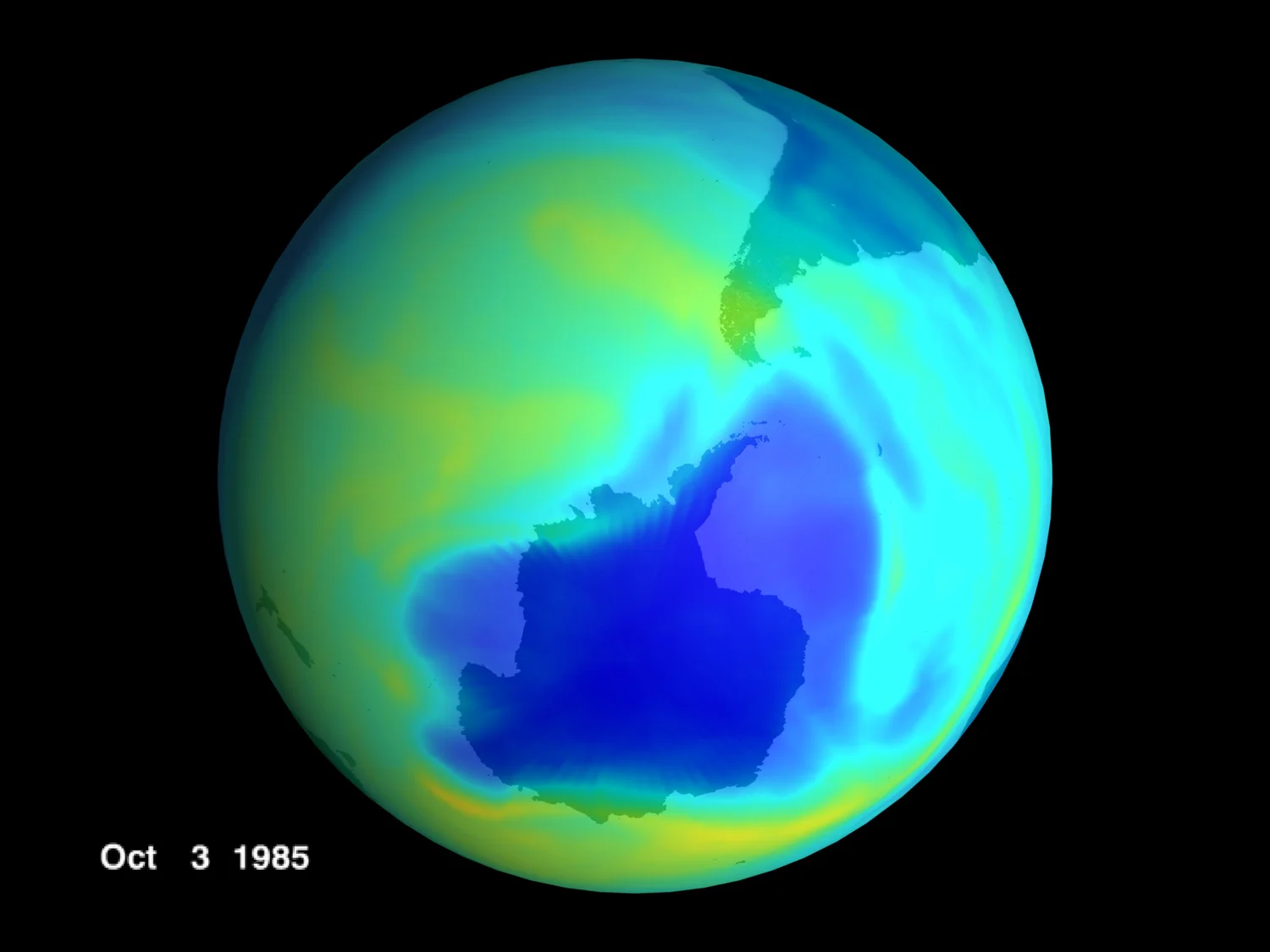
Molina and Rowland establish the link between CFCs and ozone destruction in 1974; the Antarctic “hole” is measured in 1985. Atmospheric chemistry becomes a science of thresholds.

At the same moment, neoclassical economics formalizes exactly the opposite hypothesis: Solow (1974) then Hartwick (1977) show that an economy can maintain its standard of living despite the exhaustion of a resource, provided the rents are reinvested in produced capital. Two research programmes settle in side by side, with opposite conclusions, see “Substitute or preserve”.

Institutions

🌿 Living world & territories☣️ Pollution & health⚖️ Law & institutions🌍 World🍁 Canada

Stockholm (1972) internationalizes the environment and creates UNEP ↗. Then come CITES (1973), the Convention on Long-Range Transboundary Air Pollution (1979), and the Vienna Convention (1985).

The Montreal Protocol (1987) ↗ demonstrates that a binding treaty, with a timetable and financial transfers, can bend a biophysical trajectory.

Balance of power

🧩 Interpretation🌡️ Climate & energy💰 Economy & finance🌍 World

The oil shocks of 1973 and 1979 open a window: restraint, efficiency, nuclear, renewables. It closes again on security of supply and the return of cheap oil.

The South contests a discourse of limits that would freeze existing inequalities; the neoliberal turn of 1979-1980 makes deregulation an end in itself.

Dominant discourse

🧩 Interpretation💰 Economy & finance🗣️ Discourse & opinion🌍 World

limits Exponential growth in a finite world: collapse likely in the 21st century.

abundance A technological and economic counter-discourse: ingenuity and prices settle scarcity (the Simon–Ehrlich wager, 1980).

sust. development Brundtland (1987) manufactures an ecumenical compromise: growth and environment and equity.

North-South justice “Poverty is the worst form of pollution”: development first, constraint afterwards.

Milestones that shifted the public debate

  1. 1972🌍 The Stockholm ↗ conference and the report The Limits to Growth : ecology enters the UN and the home. Perspectives: systemic, law & institutions, discourse. Status: achieved.
  2. 1972⚜️ The pamphlet La Baie James, c'est grave, grave, grave from the Comité de défense de la Baie James, and the passage of the Environment Quality Act: opposition to a megaproject and the birth of Quebec environmental law happen at the same moment. Perspectives: mobilization, law & institutions, discourse. Status: achieved.
  3. 1975⚜️ James Bay and Northern Quebec Agreement: the first modern treaty in Canada, born of a Cree and Inuit court action against a hydroelectric megaproject. Perspectives: law & institutions, mobilization, living world. Status: achieved.
  4. 1978⚜️ Creation of the BAPE: Quebec institutionalizes the public environmental hearing. Perspectives: law & institutions, mobilization. Status: achieved.
  5. 1979🌍 The Three Mile Island accident: technological risk becomes a question of democratic trust. Perspectives: pollution, discourse. Status: achieved.
  6. 1980🌍 World Conservation Strategy (IUCN, UNEP, WWF): the first international text to popularize the phrase “sustainable development”, seven years before Brundtland. Perspectives: living world, law & institutions, discourse. Status: achieved.
  7. 1984🌍 The Bhopal disaster: thousands of deaths raise the question of transnational corporate responsibility. Perspectives: pollution, economy. Status: achieved.
  8. 1985🌍 The hole in the ozone layer; the sabotage of the Rainbow Warrior by the French secret service: the repression of activism itself becomes a scandal. Perspectives: pollution, mobilization. Status: achieved.
  9. 1986🌍 Chernobyl: a transboundary radioactive cloud, the collapse of official statements, the birth of the debate on the “risk society”. Perspectives: systemic, pollution, discourse. Status: achieved.
  10. 1987🍁 Signature of the Montreal Protocol, to this day the only global environmental regime to have reversed a planetary trajectory. Perspectives: law & institutions, pollution. Status: achieved.

▲ Driving actors

  • UNEP and its executive director (Mostafa Tolba), a key negotiator on ozone
  • Club of Rome, MIT teams, the nascent field of ecological economics
  • The Cree and Inuit of Quebec: law becomes an environmental weapon
  • European green parties (1980-1983): ecology enters parliament

◆ Pivot actors

  • DuPont: long opposed to banning CFCs, then a driver once the substitutes were patented
  • The Brundtland Commission: broadens the consensus at the cost of its analytical edge
  • Oil states of the South, at once climate victims and fossil rentiers

▼ Braking actors

  • CFC producers before 1986: a campaign on scientific uncertainty
  • “Cornucopian” economists and market institutes against the very idea of a limit
  • Deregulating governments of 1979-1987, hostile to environmental standards

🍁 Canada

Advances

  • Active diplomacy on acid rain: Canada becomes a supplicant for binding international law against its neighbour.
  • Host and mediator role in the Montreal Protocol (1987).

Setbacks and blind spots

  • American obstruction on acid rain throughout the 1980s: a diplomatic dependence openly accepted.
  • Accelerated development of the oil sands, outside any climate framework.

⚜️ Quebec

Advances

  • 1972: Environment Quality Act, the lasting matrix of Quebec environmental law (authorizations, assessments, order-making powers).
  • 1978: the BAPE, a deliberative body rare in North America.
  • 1979: creation of a separate Department of the Environment.

Setbacks and blind spots

  • The JBNQA is born of a balance of legal force, not of a policy of prior consent.
  • The hydroelectric model is still assessed in megawatts, hardly at all in drowned ecosystems, mercury and hunting grounds.

Reading and reference points

B. Ward and R. Dubos, Only One Earth (1972), the manifesto-book of Stockholm · D. Meadows et al., The Limits to Growth (1972) · B. Commoner, The Closing Circle (1971) · A. Næss, “The Shallow and the Deep” (1973) · E. F. Schumacher, Small Is Beautiful (1973) · N. Georgescu-Roegen, on entropy and the economy (1971) · R. Solow, “The Economics of Resources or the Resources of Economics” (1974) · J. Hartwick, on the rule for investing rents (1977) · WCED, Our Common Future (1987) ↗.

1988 – 1997

Climate becomes a global political object, and a target for counter-expertise

InterpretationClimate governance and the doubt industry are born the same year. The whole of the later public debate follows from that simultaneity.

🌍 World 🍁 Canada ⚜️ Quebec

Knowledge

🧭 Systemic🌡️ Climate & energy🌍 World

Creation of the IPCC (1988) ↗ : an assessment institution, not a research one, designed to produce a consensus reviewed by states. First report in 1990, second in 1995 (“discernible influence” of humans on climate).

Earth system science organizes into international programmes: climate stops being an atmospheric question and becomes one of ocean-biosphere-ice couplings.

Institutions

🌡️ Climate & energy🌿 Living world & territories⚖️ Law & institutions🌍 World

Rio (1992) produces three pillars: the UNFCCC, Convention on Biological Diversity, the Convention to Combat Desertification, plus Agenda 21 and the precautionary principle.

Kyoto (1997) imposes quantified targets on industrialized countries alone and invents carbon markets: the constraint is real, but the architecture leaves the way out open.

Balance of power

🧩 Interpretation💰 Economy & finance🗣️ Discourse & opinion🌍 World🍁 Canada

The Global Climate Coalition (1989-2002), funded by oil companies and carmakers, professionalizes the manufacture of doubt, even as some of those companies' internal research confirmed the diagnosis.

The scale of that gap has now been measured. A study published in Science in 2023 ↗ assessed the sixteen climate projections produced by Exxon's own scientists between 1977 and 2003: between 63% and 83% of them match the temperatures observed since, with anticipated warming of about 0.2 °C per decade. The company had also rightly ruled out the cooling hypothesis, predicted that the human signal would become detectable around the year 2000, and estimated a carbon budget compatible with 2 °C. Its internal models performed at least as well as those of universities and public agencies, while its public communications insisted on uncertainty.

The US Senate passes the Byrd-Hagel resolution 95 to 0 (1997), condemning in advance any ratification of Kyoto: the lock is domestic before it is diplomatic.

Dominant discourse

🧩 Interpretation💰 Economy & finance🗣️ Discourse & opinion🌍 World

science alert James Hansen's testimony (1988) puts warming into the day's news.

manufactured doubt “The science isn't settled”: a strategy tested by the tobacco industry, reused unchanged.

cost-competitiveness Acting alone means losing jobs: the first great argument for delay.

ecological debt The South demands differentiated responsibilities, transfers and technology.

Milestones that shifted the public debate

  1. 1988🍁 Toronto Conference on the Changing Atmosphere: states call for a 20% cut in CO₂ by 2005. Canada is then ahead of the world. Perspectives: climate, law & institutions. Status: achieved.
  2. 1988🌍 James Hansen's testimony to the US Senate, in the middle of a heatwave: climate becomes front-page news. Perspectives: climate, discourse. Status: achieved.
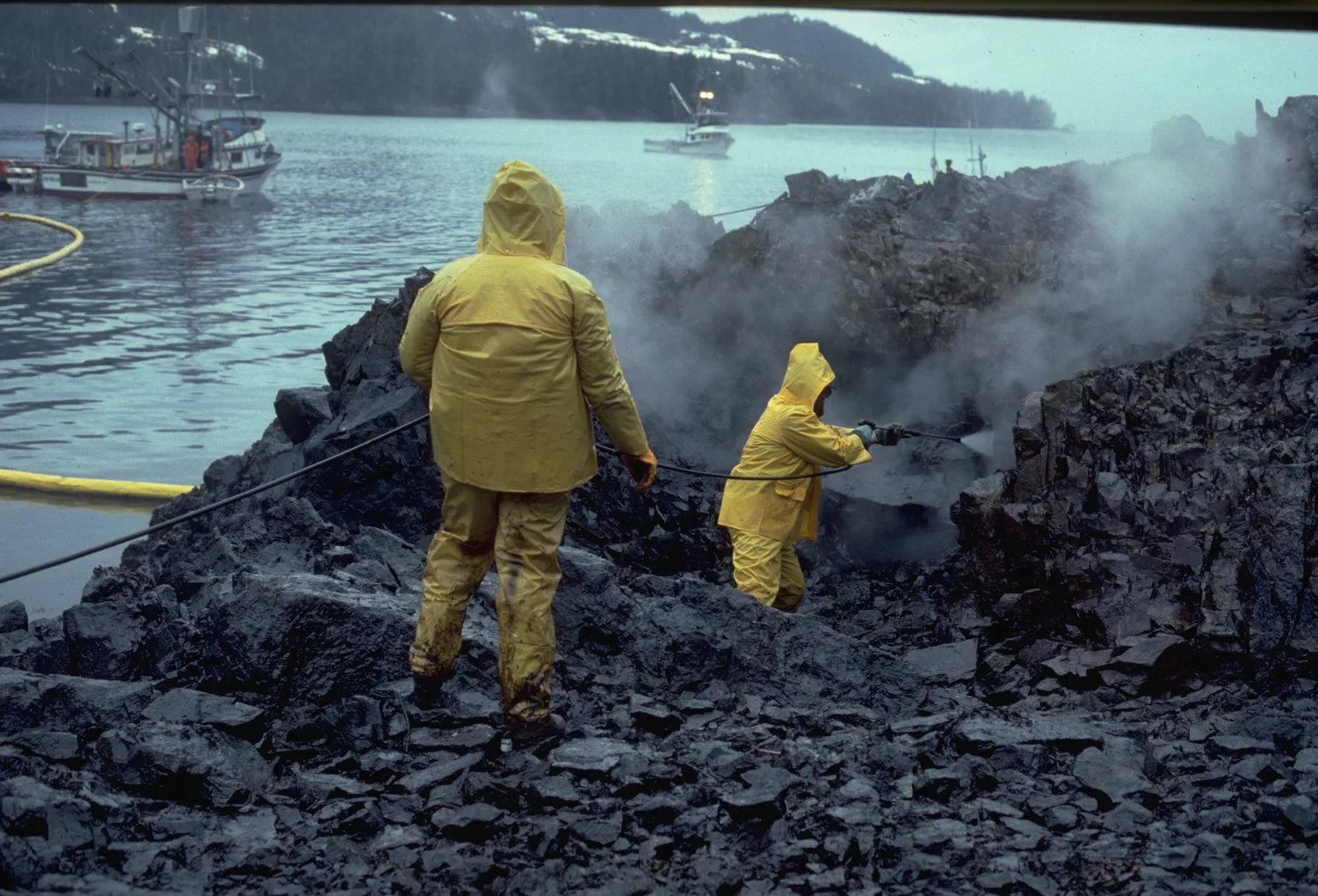
  3. 1989🌍 The wreck of theExxon Valdez : a lasting image of oil risk. Perspectives: pollution, discourse. Status: achieved.
  4. 1992🍁 Moratorium on Northern cod: a stock collapses and tens of thousands of jobs vanish: local proof that ignoring ecological thresholds destroys the economy too. Perspectives: living world, economy, systemic. Status: achieved.
  5. 1992🌍 The Rio Earth Summit: ecology becomes a subject for heads of state and mass media. Perspectives: law & institutions, discourse. Status: achieved.
  6. 1994⚜️ The Great Whale project is abandoned after an international Cree campaign: the first time a Quebec megaproject is stopped by an Indigenous and environmentalist coalition. Perspectives: mobilization, living world. Status: achieved.
  7. 1995🌍 Brent Spar and the execution of Ken Saro-Wiwa in Nigeria: the oil question becomes inseparable from human rights. Perspectives: mobilization, economy. Status: achieved.
  8. 1996⚜️ The Saguenay flood: 10 dead, villages swept away: Quebec discovers the cost of building in a flood zone. Perspectives: climate, living world. Status: achieved.

▲ Driving actors

  • IPCC, WMO, UNEP: a shared body of knowledge is institutionalized
  • AOSIS (small island states): moral and legal bearers of the urgency
  • The Cree Nation of Quebec (Matthew Coon Come): international success against Great Whale
  • Mass environmental NGOs and ecofeminism from the South (Vandana Shiva)

◆ Pivot actors

  • The European Union: ambitious in discourse, dependent on coal and gas in practice
  • Canada: diplomatic leader at Toronto and Rio, and a growing hydrocarbon producer
  • The World Bank and the IMF: financing both adaptation and fossil infrastructure

▼ Braking actors

  • The Global Climate Coalition and institutes funded by the fossil industry
  • The US Senate (Byrd-Hagel resolution, 1997)
  • OPEC oil producers in the UN negotiations
  • Automobile associations against efficiency standards

🍁 Canada

Advances

  • 1988: Canadian Environmental Protection Act; leadership at the Toronto Conference.
  • 1992: signature of the UNFCCC and the Convention on Biological Diversity at Rio.
  • 1995: the Canadian Environmental Assessment Act comes into force.

Setbacks and blind spots

  • Collapse of the cod: the fisheries science was available; the political decision followed the industry.
  • No serious domestic policy follows the international commitments: the gap between diplomacy and implementation sets in.
  • Continued growth in oil and gas emissions in the West.

⚜️ Quebec

Advances

  • Hydroelectricity becomes a climate argument: Quebec positions itself as a distinct subnational actor.
  • The halting of Great Whale: Indigenous consent enters the energy equation for good.
  • After 1996, an overhaul of flood and dam risk management.

Setbacks and blind spots

  • Urban sprawl and car dependence accelerate, outside any climate framing.
  • The favourable carbon balance masks a heavy industry and intense material consumption.

Reading and reference points

IPCC, first and second assessment reports (1990, 1995) · V. Shiva, Staying Alive (1988) · U. Beck, Risk Society (trans. 1992) · H. Daly, Beyond Growth (1996) · E. Ostrom, Governing the Commons (1990) · N. Oreskes and E. Conway, Merchants of Doubt (2010) · G. Supran, S. Rahmstorf and N. Oreskes, “Assessing ExxonMobil's global warming projections”, Science (2023).

1998 – 2007

Ratify without transforming: the decade of the gap

InterpretationWe learn to measure, to negotiate and to account far faster than we learn to transform infrastructure. The gap between the signature and the result becomes structural.

🌍 World 🍁 Canada ⚜️ Quebec

Knowledge

🧭 Systemic🌡️ Climate & energy🌿 Living world & territories🌍 World

The IPCC's third (2001) and fourth (2007) reports consolidate human attribution; the fourth earns the IPCC the Nobel Peace Prize, shared with Al Gore.

The Millennium Ecosystem Assessment (2005) shows that most of the world's ecosystem services are degrading: the living world becomes an explicit economic issue. The Stern Review (2006) prices inaction as a cost, not as prudence.

Institutions

🌡️ Climate & energy⚖️ Law & institutions💰 Economy & finance🌍 World

Kyoto enters into force in 2005; the European Union launches its carbon market the same year. National inventories, accounting, flexibility mechanisms and offset credits all become professionalized.

A bureaucratic expertise is built, but it bears on measurement andexchange of emissions, far more than on the physical investments that produce them.

Balance of power

🧩 Interpretation🌡️ Climate & energy💰 Economy & finance🌍 World🍁 Canada

China's entry into the WTO (2001) shifts world production: rich countries cut territorial emissions while importing embodied ones.

The oil price soars, the oil sands become profitable, western Canada becomes a pole of accumulation. The American withdrawal from Kyoto (2001) deprives the regime of its largest historical emitter.

Dominant discourse

🧩 Interpretation💰 Economy & finance🗣️ Discourse & opinion🌍 World

too expensive Doubt recedes, cost takes over: “not at that price, not now, not alone”.

leakage “Our factories will go elsewhere”: the carbon leakage argument becomes a permanent veto.

individual responsibility Popularization of the personal “carbon footprint”, a framing widely circulated by oil industry advertising, which shifts the burden from producer to consumer.

revelation An Inconvenient Truth (2006) makes climate an object of popular culture.

Milestones that shifted the public debate

  1. 1998⚜️ The ice storm: up to 1.4 million households without power, some for more than three weeks. Grid vulnerability becomes a political subject. Perspectives: climate, economy. Status: achieved.
  2. 2001🌍 US withdrawal from the Kyoto Protocol: climate cooperation becomes explicitly reversible. Perspectives: law & institutions, climate. Status: achieved.
  3. 2002🌍 The Johannesburg Summit: sustainable development is institutionalized into voluntary partnerships, just as the climate regime weakens. Perspectives: law & institutions, economy. Status: achieved.
  4. 2003🌍 European heatwave: tens of thousands dead. Heat becomes a mass health risk, not a discomfort. Perspectives: climate. Status: achieved.
  5. 2004⚜️ The Suroît gas plant is abandoned after public opposition and an unfavourable opinion: social acceptability becomes a decisive factor in Quebec. Perspectives: mobilization, climate. Status: achieved.
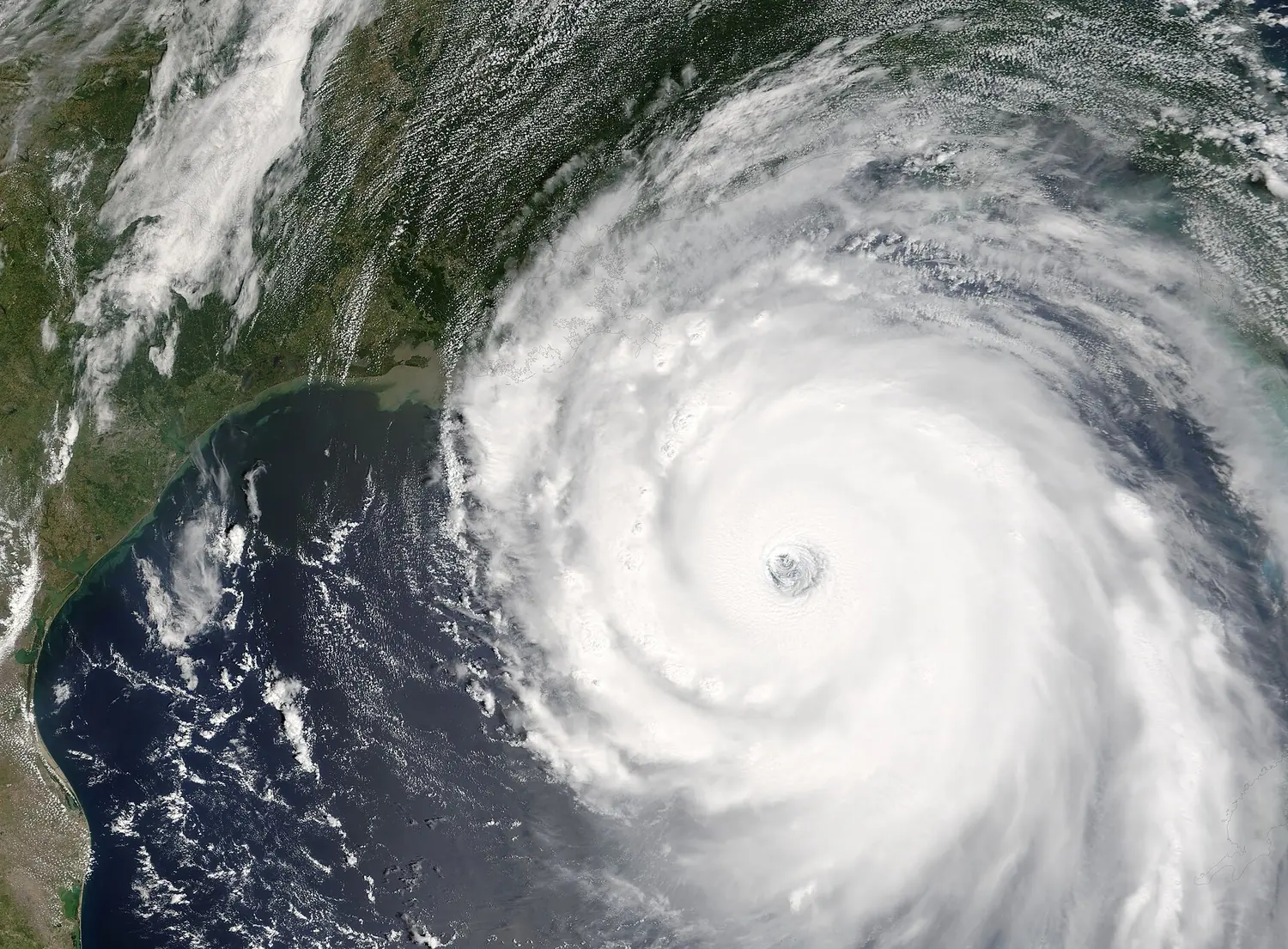
  6. 2005🌍 Hurricane Katrina: the disaster reveals that climate risk strikes along lines of class and race. Perspectives: climate, mobilization. Status: achieved.
  7. 2006🌍 Stern Review and An Inconvenient Truth : climate becomes an economic subject and a mainstream one at the same time. Perspectives: discourse, economy. Status: achieved.
  8. 2006-2007🍁 Change of federal government: climate programmes abandoned, de facto exit from the Kyoto trajectory. Perspectives: law & institutions, discourse. Status: achieved.
  9. 2007⚜️ First carbon levy in North America, charged to fossil energy distributors to fund the Green Fund. Perspectives: law & institutions, economy, climate. Status: achieved.

▲ Driving actors

  • The European Union: first large-scale carbon market
  • Subnational governments (California, Quebec) legislating without waiting for their federal state
  • Climate economists (Stern): a shift from moral framing to financial framing
  • Municipalities and city networks

◆ Pivot actors

  • Large companies adopting voluntary targets while funding regulatory opposition
  • Industrial unions: in favour of transition, hostile to closures without a plan
  • Emerging countries: first in volume of emissions, last in cumulative emissions per head

▼ Braking actors

  • The post-2001 US administration and its allies in the negotiations
  • The Canadian Association of Petroleum Producers and the Alberta government
  • Market institutes circulating recycled doubt (Fraser Institute, Friends of Science)
  • Finance ministries, guardians of the “cost to competitiveness”

🍁 Canada

Advances

  • 2002: ratification of the Kyoto Protocol despite strong provincial and industrial opposition.
  • 1999: overhaul of the Canadian Environmental Protection Act (toxic substances).

Setbacks and blind spots

  • Emissions rise markedly after ratification: commitment without implementation.
  • 2006-2007: dismantling of federal programmes and open refusal of the Kyoto target.
  • Unchecked growth of the oil sands, presented as a national economic necessity.

⚜️ Quebec

Advances

  • 2006: Sustainable Development Act and first Climate Change Action Plan.
  • 2007: carbon levy, the first in North America: Quebec picks the price instrument early.
  • The Suroît: proof that a fossil project can be stopped by public debate.

Setbacks and blind spots

  • Transport becomes the largest source of emissions and keeps growing (light trucks, sprawl).
  • The Green Fund will long suffer from a deficit of accountability and effectiveness.

Reading and reference points

IPCC, third and fourth reports (2001, 2007) · Millennium Ecosystem Assessment (2005) · N. Stern, Stern Review (2006) · J. B. Foster, Marx's Ecology (2000) · J. Diamond, Collapse (2005) · W. Sachs, Planet Dialectics (1999).

2008 – 2015

Planetary boundaries, national deadlock, the Paris compromise

InterpretationScience proposes a unified frame (the safe operating space) at the precise moment when Canadian politics takes the opposite road. The mismatch between scales becomes the heart of the problem.

🌍 World 🍁 Canada ⚜️ Quebec

Knowledge

🧭 Systemic🌡️ Climate & energy🌿 Living world & territories🌍 World

The framework of planetary boundaries (2009, revised 2015) ↗ reorganizes the problem: nine interdependent processes define a safe operating space for humanity. In 2012 Kate Raworth adds a social floor to it, the “doughnut”.

The IPCC's fifth report (2013-2014) establishes the carbon budget : warming depends on cumulative emissions. From then on, climate policy becomes a policy of total quantities, not of intentions.

Institutions

🌡️ Climate & energy⚖️ Law & institutions🌍 World

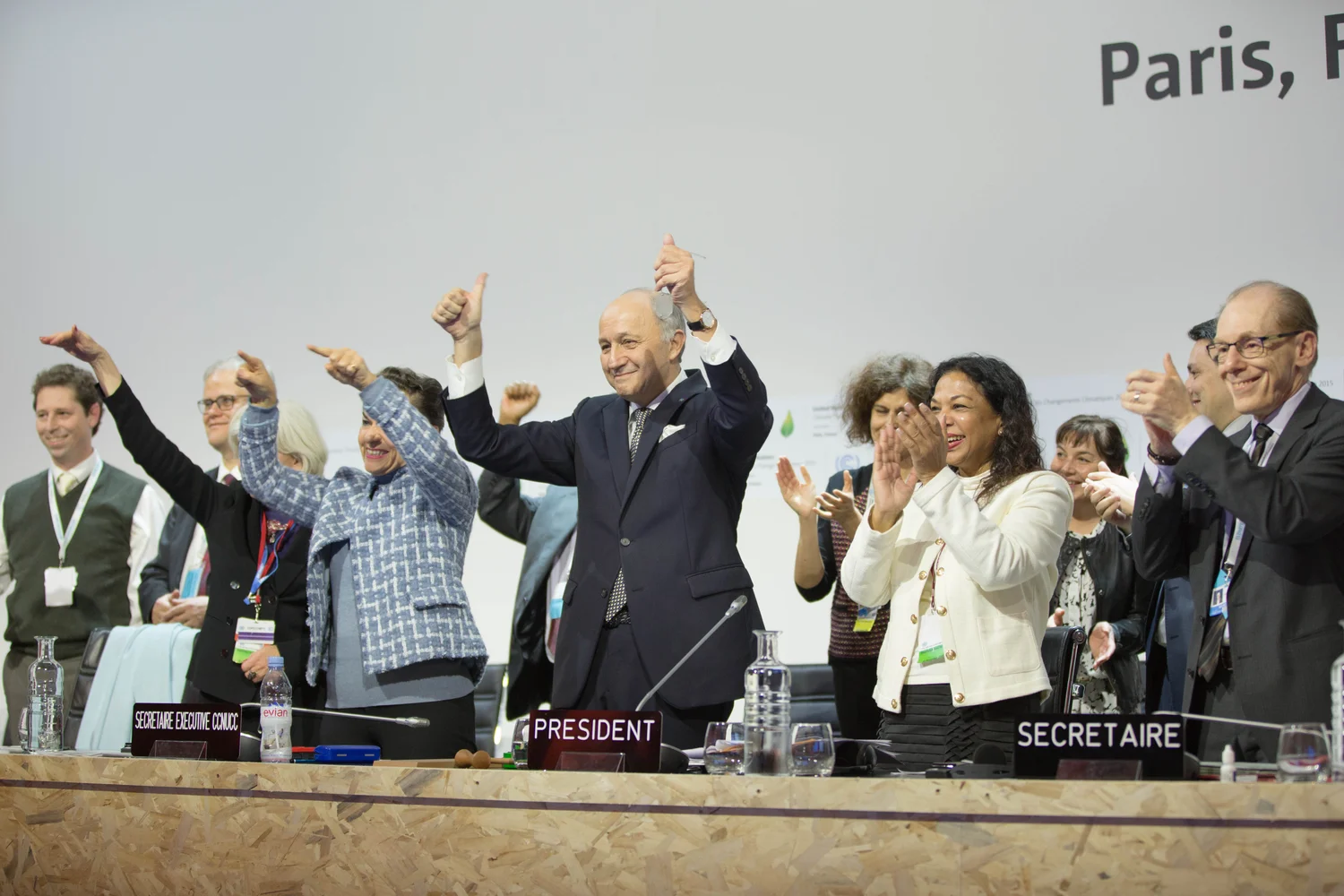
After the failure of Copenhagen (2009), governance is rebuilt from below: nationally determined contributions, transparency, five-yearly review. TheParis Agreement (2015) and the Sustainable Development Goals universalize the framework.

National monitoring institutions appear (independent climate councils, carbon budgets, framework laws), on the British model of 2008.

Balance of power

🧩 Interpretation⚖️ Law & institutions💰 Economy & finance🌍 World🍁 Canada

The financial crisis makes austerity the budgetary horizon, while producing the first large green stimulus plans. The shale gas revolution lowers the price of fossil energy.

In Canada, the federal state aligns itself with oil development: withdrawal from Kyoto, reduction of environmental law, control of public scientific speech, surveillance of environmental charities.

Dominant discourse

🧩 Interpretation✊ Mobilization & justice🗣️ Discourse & opinion🌍 World🍁 Canada

ethical oil An inverted moral framing: Canadian oil is said to be preferable to that of authoritarian regimes.

foreign radicals Pipeline opponents are cast as externally funded: the symbolic criminalization of dissent.

green growth A promised decoupling of GDP from impacts, at the heart of the institutional consensus.

climate justice Naomi Klein, Laudato si' and the divestment movement explicitly link climate, capitalism and inequality.

Milestones that shifted the public debate

  1. 2009🌍 The failure of Copenhagen and the so-called “Climategate” affair: manufactured controversy reaches peak effectiveness. Perspectives: law & institutions, discourse. Status: achieved.
  2. 2010🌍 The Deepwater Horizon oil spill: the risk of deep exploration becomes tangible. Perspectives: pollution, economy. Status: achieved.
  3. 2011🍁 Canada withdraws from the Kyoto Protocol, a world precedent for disengaging from a climate treaty. Perspectives: law & institutions, climate. Status: achieved.
  4. 2012🍁 Omnibus budget bills: weakening of protections for navigable waters, fisheries and environmental assessment. Birth of the Idle No More. Perspectives: law & institutions, mobilization, living world. Status: achieved.
  5. 2012🌍 Rio+20: the “green economy” becomes the official frame and the Sustainable Development Goals process is launched. Perspectives: law & institutions, economy. Status: achieved.
  6. 2013⚜️ The Lac-Mégantic rail disaster: 47 dead. Transporting oil stops being a technical question and becomes one of public safety. Perspectives: economy, pollution, mobilization. Status: achieved.
  7. 2013-2014⚜️ Launch of the cap-and-trade system, then linkage with California: the largest subnational carbon market in North America. Perspectives: law & institutions, economy, climate. Status: achieved.
  8. 2015🌍 Laudato si' : a global moral and religious framing, read well beyond ecological circles. Perspectives: discourse, mobilization. Status: achieved.
  9. 2015🌍 The Paris Agreement; the Volkswagen scandal: trust in corporate self-reporting collapses. Perspectives: law & institutions, discourse. Status: achieved.

▲ Driving actors

  • The Stockholm Resilience Centre and the Earth system community
  • Indigenous nations opposed to pipelines and extractive expansion
  • The divestment movement, universities, pension funds
  • Quebec coalitions against Energy East and oil exploration

◆ Pivot actors

  • Institutional investors: they discover “carbon risk” without reducing their exposure
  • Canadian provinces: British Columbia prices carbon from 2008, Alberta resists
  • Hydro-Québec: a climate asset, but the operator of contested megaprojects

▼ Braking actors

  • The federal government of 2008-2015: withdrawal from Kyoto, deregulation, control of scientific communication
  • The oil sands industry and its media relays
  • Promoters of interprovincial and cross-border pipelines

🍁 Canada

Advances

  • 2008: British Columbia's carbon tax, the first of its kind in North America and a model studied worldwide.
  • 2015: accession to the Paris Agreement and the return of active climate diplomacy.
  • A judicial counterweight: the courts strike down project approvals for insufficient Indigenous consultation.

Setbacks and blind spots

  • 2011: withdrawal from Kyoto; 2012: major reduction of federal environmental law.
  • Restrictions on federal scientists' communications, targeted audits of environmental organizations.
  • No binding sectoral target for oil and gas.

⚜️ Quebec

Advances

  • 2013-2014: the cap-and-trade system operational and linked to California; the revenue funds Quebec's climate fund.
  • 2011-2014: a de facto moratorium on shale gas after an unfavourable public assessment.
  • Broad opposition to Energy East, tying together water risks, Indigenous rights and climate.

Setbacks and blind spots

  • Public investment in oil exploration on Anticosti, later abandoned at great cost.
  • The carbon price stays too low to change land use and mobility decisions.

Reading and reference points

J. Rockström et al., “A Safe Operating Space for Humanity” (2009) · W. Steffen et al., “Planetary Boundaries” (2015) · K. Raworth, Doughnut Economics (2017, from 2012) · N. Klein, This Changes Everything (2014) · A. Malm, Fossil Capital (2016) · Pope Francis, Laudato si' (2015).

2016 – 2020

Contradictions in plain sight: emergency declared, expansion continued

InterpretationParliaments declare a climate emergency and approve fossil infrastructure in the same week. The contradiction becomes public, measurable and documented, and a green communications industry sets itself up to make it bearable.

🌍 World 🍁 Canada ⚜️ Quebec

Knowledge

🌡️ Climate & energy🌿 Living world & territories🌍 World

The IPCC special report on 1.5 °C (2018) ↗ shows that the half-degree between 1.5 and 2 changes reefs, yields and heatwaves: the debate moves from direction to speed.

The global assessment ofIPBES (2019) ↗ estimates that around one million species are threatened with extinction. Attribution science now makes it possible to tie specific events to warming.

Institutions

⚖️ Law & institutions✊ Mobilization & justice🌍 World🍁 Canada

Law becomes a battleground: national climate acts, net-zero targets, independent advisory councils, financial disclosure obligations, and above all litigation: the Urgenda case (2019) confirms that a state can be ordered to cut its emissions.

In Canada, federal carbon pricing (2018) is challenged by several provinces before the courts; impact assessment is reformed in 2019.

Balance of power

🧩 Interpretation✊ Mobilization & justice💰 Economy & finance🌍 World🍁 Canada

The American withdrawal from the Paris Agreement (announced in 2017) reopens the free-rider question. In 2018 Canada buys the Trans Mountain pipeline, for want of a private investor willing to carry the political risk.

Conflicts shift towards territory and consent: the 2020 rail crisis over the Coastal GasLink pipeline sets Canadian law against Wet'suwet'en hereditary governance.

Dominant discourse

🧩 Interpretation✊ Mobilization & justice🗣️ Discourse & opinion🌍 World

emergency Parliamentary declarations of climate emergency, sometimes followed the next day by approvals of fossil projects.

just transition Entry into official vocabulary, first of all for coal workers.

net zero by 2050 A new consensus: a distant target that makes it possible to defer the near decisions.

affordability The carbon price is recast as a cost-of-living issue: the matrix of the backlash to come.

Milestones that shifted the public debate

  1. 2016🍁 The Fort McMurray fire: around 88,000 people evacuated, in the very heart of the oil region. Perspectives: climate, living world. Status: achieved.
  2. 2018🌍 The IPCC's 1.5 °C report, then the school strike started by Greta Thunberg: the birth of a global youth movement. Perspectives: climate, mobilization, discourse. Status: achieved.
  3. 2018⚜️ The Pacte pour la transition: more than 250,000 signatures in Quebec, a cultural phenomenon as much as a political one. Perspectives: mobilization, discourse. Status: achieved.
  4. 2019🌍 The IPBES report; the Urgenda ruling; fires in the Amazon and Australia: biodiversity and fire enter the climate debate. Perspectives: living world, law & institutions. Status: achieved.
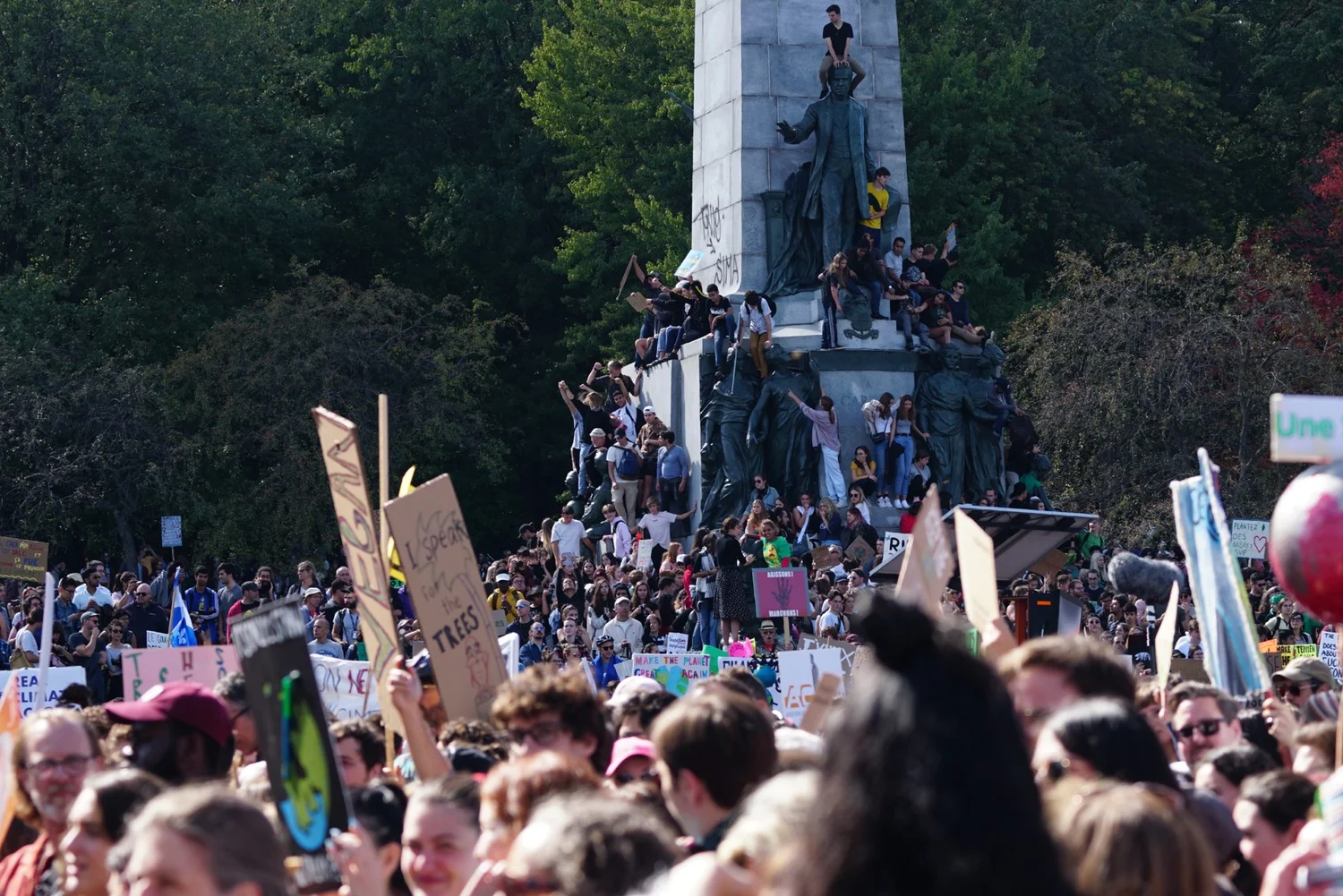
  5. 2019⚜️ The march of 27 September in Montreal: around half a million people, the largest demonstration in Quebec's history. Perspectives: mobilization. Status: achieved.
  6. 2019🍁 The House of Commons declares a climate emergency and approves the Trans Mountain expansion the next day. Perspectives: law & institutions, discourse. Status: achieved.
  7. 2020🍁 Rail blockades in solidarity with the Wet'suwet'en hereditary chiefs: Indigenous consent becomes a central project risk. Perspectives: mobilization, law & institutions, economy. Status: achieved.
  8. 2020🌍 Pandemic: a sharp fall then a rebound in emissions: proof that a non-structural drop does not last. Perspectives: climate, economy. Status: achieved.
🫧

All hands to the greenwashing

From 2016, and massively after 2019, climate commitment becomes a communications product: promises of “net zero by 2050” with no near-term target, voluminous ESG reports, advertising about “responsible energy”, unverifiable forest offsets, sponsorship of museums, universities and sports teams.

Its political function is precise: to occupy the space of discourse while investment continues, and to cover, in both senses of the word, a decade of inaction. It is also what makes the period hard to assess: announcements multiply faster than reductions. It took until 2024 for a serious legal constraint to appear in Canada, with the anti-greenwashing provisions of the Competition Act, and for it to emerge that several companies would rather fall silent than prove their claims.

▲ Driving actors

  • Youth movements (school strikes), Extinction Rebellion
  • Indigenous nations and the courts: consent, Aboriginal title, duties to consult
  • Climate litigation (Urgenda) and environmental lawyers
  • Cities and regions signing climate commitments

◆ Pivot actors

  • The federal government: carbon pricing and purchase of a pipeline
  • Banks and insurers: warnings about climate risk, fossil financing maintained
  • Energy sector unions, asking for job guarantees

▼ Braking actors

  • The US administration of 2017-2020: withdrawal from Paris, massive deregulation
  • The governments of Alberta, Saskatchewan and Ontario against federal pricing
  • Fossil industry public relations campaigns on “affordable energy”

🍁 Canada

Advances

  • 2016: Pan-Canadian Framework on Clean Growth; coal phase-out planned for 2030.
  • 2018: federal carbon pricing backstop, later upheld by the Supreme Court.
  • 2019: new Impact Assessment Act and a tanker ban on the northern Pacific coast.

Setbacks and blind spots

  • 2018: public purchase of the Trans Mountain pipeline, a lasting financial commitment to oil expansion.
  • A federal-provincial legal war that immobilizes several years of climate policy.
  • The emergency is declared without a binding sectoral plan for oil and gas.

⚜️ Quebec

Advances

  • 2020: creation of the Advisory Committee on Climate Change ↗ and the Plan for a Green Economy 2030.
  • Citizen mobilization on an unprecedented scale, which puts climate at the centre of the election debate.
  • The 2030 target written into law, with an obligation of periodic review.

Setbacks and blind spots

  • Major road projects pursued alongside the climate targets.
  • The Plan leans heavily on electrification and little on material restraint or land use.

Reading and reference points

IPCC, Global Warming of 1.5 °C (2018) · IPBES, Global Assessment (2019) · W. Lamb et al., “Discourses of Climate Delay” (2020) · K. Whyte, on colonialism and climate (2017) · A. Malm and the debate on movement strategy (2020) · D. Wallace-Wells, The Uninhabitable Earth (2019).

2021 – 2024

Polycrisis: deliver, absorb the impacts, weather the backlash

InterpretationThe targets exist, and so do the laws. What is missing now is the capacity to deliver, and political legitimacy, attacked by the cost of living as much as by the fossil industries.

🌍 World 🍁 Canada ⚜️ Quebec

Knowledge

🧭 Systemic🌡️ Climate & energy🌿 Living world & territories🌍 World

The IPCC's sixth cycle (2021-2023) confirms that every tenth of a degree counts and that adaptation options have limits of their own. Work on tipping points (ice sheets, the Amazon, ocean circulation) enters public debate.

In 2023, an update of the planetary boundaries concludes that six of the nine are crossed. Risk becomes compound : climate, biodiversity, water, health and food can no longer be treated separately.

Institutions

🌡️ Climate & energy🌿 Living world & territories⚖️ Law & institutions🌍 World🍁 Canada

The COP15 in Montreal (2022) adopts the Global Biodiversity Framework, including the target of 30% protected areas by 2030. COP28 (2023) mentions a transition away from fossil fuels for the first time; COP27 creates the loss and damage fund.

In Canada: net-zero act (2021), carbon pricing upheld by the Supreme Court (2021), 2030 reduction plan (2022), zero-emission vehicle standard (2023), proposed oil and gas cap (2024) announced.

Balance of power

🧩 Interpretation🌡️ Climate & energy💰 Economy & finance🌍 World🍁 Canada

The invasion of Ukraine (2022) makes energy security the dominant argument: a revival of LNG, coal and defence budgets. The American Inflation Reduction Act (2022) sets off a global race in green industrial subsidies.

Inflation turns the carbon price into a symbol of the cost of living. In Canada, the home heating oil exemption (2023) undermines the scheme's universality and feeds provincial opposition.

Dominant discourse

🧩 Interpretation💰 Economy & finance🗣️ Discourse & opinion🌍 World🍁 Canada

energy security Producing more becomes a geopolitical duty.

affordability “Axe the tax”: a simple slogan against a complex and poorly explained instrument.

solutionism Carbon capture, hydrogen, small reactors: promises that justify not cutting production today.

adaptation Insurers and municipalities impose a new vocabulary: flooding, heat, insurability, resilience.

Milestones that shifted the public debate

  1. 2021🍁 Heat dome in British Columbia: 49.6 °C at Lytton, a village destroyed by fire the next day, several hundred heat-related deaths. Perspectives: climate, living world. Status: achieved.
  2. 2021⚜️ Rejection of the GNL Québec project and its pipeline, after an unfavourable environmental assessment and massive public opposition. Perspectives: mobilization, law & institutions, economy. Status: achieved.
  3. 2022⚜️ Quebec legislates to end hydrocarbon exploration and production on its territory, a world first at that scale. Perspectives: law & institutions, climate. Status: achieved.
  4. 2022🌍 Invasion of Ukraine: energy crisis, and the return of the fossil sovereignty argument. Perspectives: economy, climate. Status: achieved.
  5. 2022⚜️ COP15 in Montreal: adoption of the Kunming-Montreal Global Biodiversity Framework. Perspectives: law & institutions, living world. Status: achieved.
  6. 2023🌍 A study published in Science quantifies for the first time an oil company's internal climate projections: between 1977 and 2003, Exxon predicted warming as accurately as public laboratories, while its public communications insisted on uncertainty. Perspectives: discourse, economy. Status: achieved.
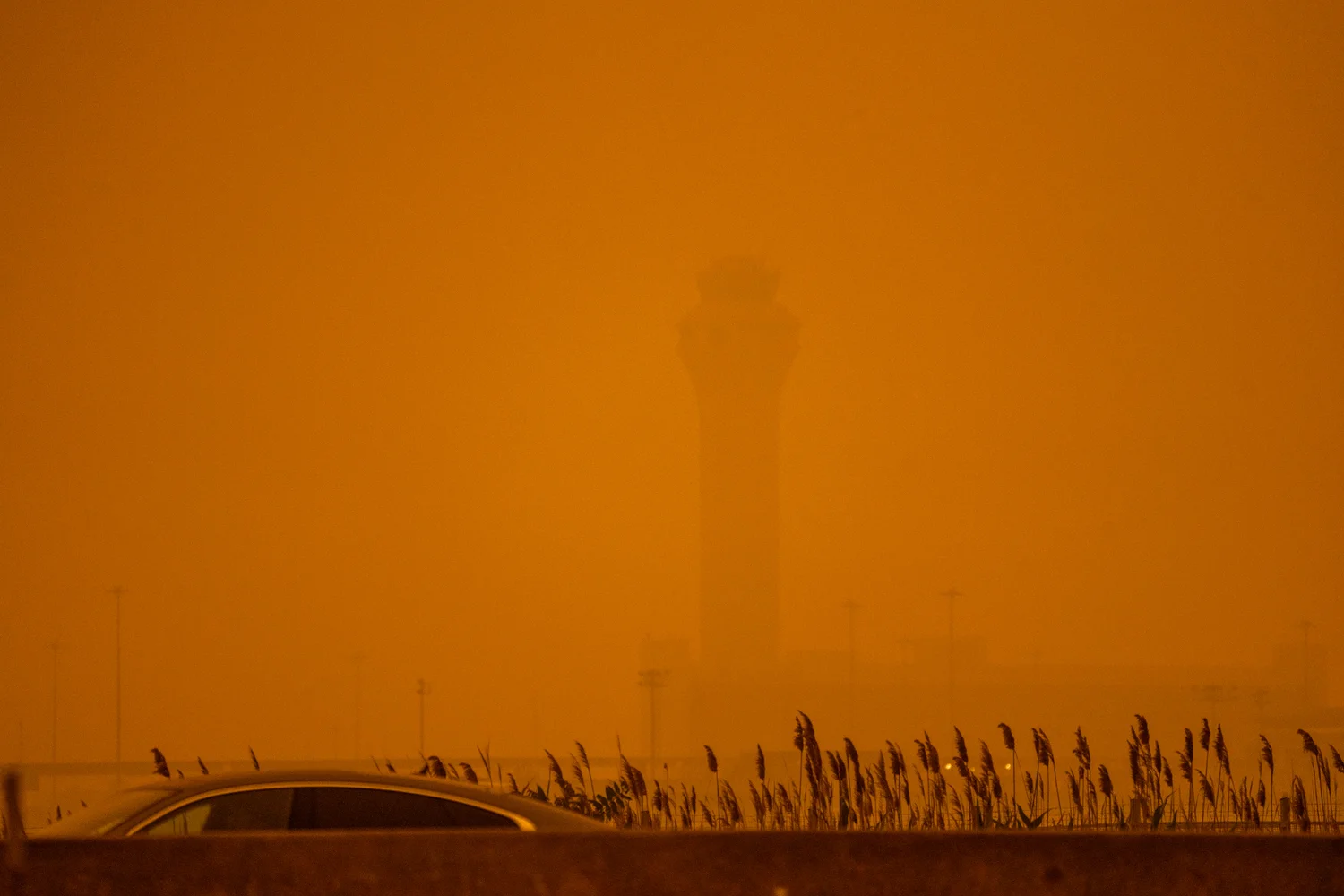
  7. 2023🍁 The largest wildfire season ever recorded in Canada: mass evacuations, smoke across North America: air becomes a collective experience of warming. Perspectives: climate, living world, pollution. Status: achieved.
  8. 2024🍁 Bill C-59: every environmental claim must now rest on adequate testing and recognized methods, with a private right of action before the Competition Tribunal. Within days, the Pathways Alliance and several oil companies strip the environmental content from their websites: greenwashing gives way to “greenhushing”. Perspectives: law & institutions, discourse, economy. Status: achieved.
  9. 2024🍁 The costliest year in Canadian history for insured damage ($8.5 B); the remnants of Hurricane Debby cause $2.7 B of damage in Quebec, the costliest disaster in its history. Perspectives: economy, climate. Status: achieved.
  10. 2024🌍 The stratigraphy bodies reject the Anthropocene as a formal geological epoch. The term remains central in public debate: a concept can be scientifically unsettled and politically decisive. Perspectives: systemic, discourse. Status: disputed.
  11. 2024🌍 The first calendar year above 1.5 °C over the pre-industrial era. Perspectives: climate, systemic. Status: achieved.

▲ Driving actors

  • Municipalities and insurers, unexpected drivers of adaptation
  • Independent monitoring bodies (Canadian Climate Institute, advisory committees)
  • Indigenous nations, now co-owners of energy projects and guardians of protected territories
  • The electrical and manufacturing industry of the transition

◆ Pivot actors

  • Successive federal governments: ambitious targets, fossil infrastructure completed
  • Hydro-Québec: a historic investment plan, but constrained by acceptability and capacity
  • Major oil companies: net-zero commitments and simultaneous production expansion

▼ Braking actors

  • Western provincial governments challenging federal jurisdiction
  • A political campaign against carbon pricing
  • The fossil industry lobby promoting capture rather than production cuts

🍁 Canada

Advances

  • 2021: Canadian Net-Zero Emissions Accountability Act and constitutional validation of carbon pricing.
  • 2022-2024: 2030 reduction plan, clean fuel regulations, methane regulations, zero-emission vehicle sales standard.
  • 2024: Sustainable Jobs Act; commitment to protect 30% of the territory by 2030. projected

Setbacks and blind spots

  • 2024: completion of the Trans Mountain expansion, at a public cost of around $34 B.
  • 2023: home heating oil exemption, a major political breach in the logic of carbon pricing.
  • National emissions stagnate: sectoral gains are cancelled out by the growth of oil and gas.

⚜️ Quebec

Advances

  • 2021-2022: rejection of GNL Québec, then the legal end of hydrocarbon exploration and production.
  • 2023: Hydro-Québec's 2035 action plan (investment of the order of $155 to $185 B) and the rise of wind power in partnership with communities.
  • 2024 : Plan Nature 2030 ↗ funded with $922 M for biodiversity and protected areas.

Setbacks and blind spots

  • Woodland caribou: the overall strategy is put off, reduced to pilot projects despite protected-area plans already prepared.
  • The battery sector weakened: the bankruptcy of Northvolt and several partners, with substantial public losses.
  • Road projects and urban sprawl maintained; transport remains the largest source of emissions.

Reading and reference points

IPCC, sixth assessment report (2021-2023) · K. Richardson et al., “Earth beyond six of nine planetary boundaries” (2023) · A. Armstrong McKay et al., on tipping points (2022) · the degrowth debate · Canadian Climate Institute, annual reports on emissions and adaptation.

2025 – 2026

Political retreat, thresholds crossed: the parting of ways

InterpretationKnowledge has never been more solid, nor international law more explicit, and yet several rich states openly slow down. The conflict no longer bears on the facts, but on the trajectory.

🌍 World 🍁 Canada ⚜️ Quebec

Knowledge

🧭 Systemic🌡️ Climate & energy☣️ Pollution & health🌍 World

The Planetary Health Check 2025 ↗ concludes that seven of the nine planetary boundaries are crossed: ocean acidification joins the list. Only stratospheric ozone and aerosols remain in the safe zone, precisely the two areas where determined public action was taken.

The WMO confirms that 2025 is one of the three warmest years ever measured and that the 2023-2025 average exceeds the pre-industrial era by about 1.48 °C: the first three-year period above 1.5 °C.

Institutions

⚖️ Law & institutions✊ Mobilization & justice🌍 World

On 23 July 2025, the International Court of Justice ↗ delivers a unanimous opinion: states have an obligation to prevent significant environmental harm and to cooperate in good faith; breaches may engage their responsibility and give rise to reparation.

The COP30 in Belém ↗ triples the adaptation finance goal by 2035 (a commitment, not a payment) but fails to adopt a roadmap out of fossil fuels; two voluntary roadmaps, with no binding force, are referred to COP31. Negotiations on plastics remain blocked, the decisive session postponed to 2027.

Balance of power

🧩 Interpretation🌡️ Climate & energy💰 Economy & finance🌍 World🍁 Canada

The American withdrawal from the Paris Agreement and the priority given to hydrocarbons weaken cooperation. The North American trade war supplies a sovereignty argument for Canadian oil expansion.

In Canada, the government openly changes doctrine: bet on investment rather than on targets and regulations. Independent analyses conclude that net zero by 2050 becomes unreachable under those conditions.

Dominant discourse

🧩 Interpretation⚖️ Law & institutions🗣️ Discourse & opinion🌍 World🍁 Canada

green pragmatism The phrase used by Quebec to justify deferring its target: hold the course, slow the pace.

invest, don't target “We have relied too much on targets and laws”: constraint is presented as ineffective by nature.

sovereignty The pipeline becomes a nation-building project in the face of American pressure.

technical conditionality Expansion is authorized because a carbon capture project is promised in return.

habitability On the opposite side: the costs of inaction, insurability, legal obligations and intergenerational fairness become the language of the counterweights.

Milestones that shifted the public debate

  1. Jan. 2025🌍 A further American withdrawal from the Paris Agreement, effective January 2026. Perspectives: law & institutions, climate. Status: achieved.
  2. Apr. 2025🍁 The federal fuel charge is brought to zero: consumer carbon pricing disappears, then is repealed by legislation. Perspectives: law & institutions, economy. Status: achieved.
  3. June 2025🍁 Building Canada Act: projects declared of “national interest” and a Major Projects Office, despite strong Indigenous opposition. Perspectives: law & institutions, mobilization, economy. Status: achieved.
  4. July 2025🌍 Unanimous advisory opinion of the International Court of Justice on states' climate obligations. Perspectives: law & institutions, mobilization. Status: achieved.
  5. Aug. 2025🌍 Failure of the plastics treaty negotiations in Geneva; the decisive session is pushed back to 2027. Perspectives: law & institutions, pollution. Status: announced, with no legal effect to date.
  6. Sept. 2025🌍 Seventh planetary boundary crossed: ocean acidification. Perspectives: systemic, pollution. Status: achieved.
  7. Nov. 2025🍁 Ottawa-Alberta memorandum of understanding ↗ : support for a one-million-barrel-a-day pipeline, withdrawal of the oil and gas emissions cap, loosening of the clean electricity regulations, a five-year deferral of the methane target. Steven Guilbeault leaves Cabinet. Perspectives: law & institutions, economy, climate. Status: announced, with no legal effect to date.
  8. Jan. 2026⚜️ Quebec's target deferred ↗ from -37.5% by 2030 to 2035, against the advice of the Advisory Committee and the consensus of the public consultations. Perspectives: law & institutions, climate. Status: achieved.
  9. June 2026⚜️ Washington State joins the carbon market ↗ with Quebec and California: the largest market linking subnational governments expands. Perspectives: law & institutions, economy, climate. Status: achieved.
  10. July 2026🍁 Pathways protocol signed with five oil sands producers; in the middle of the fire season, the prime minister accepts that his decisions will raise emissions in the short term. Perspectives: economy, climate, discourse. Status: announced, with no legal effect to date.

▲ Driving actors

  • The International Court of Justice, small island states, Vanuatu: the judicialization of climate
  • The Colombia–Netherlands coalition for a fossil fuel phase-out conference (2026)
  • Quebec's Advisory Committee, the Canadian Climate Institute, auditors general
  • California and Washington State, partners in Quebec's carbon market
  • Équiterre, Greenpeace, CPAWS, the Bloc Québécois and Québec solidaire in parliamentary settings

◆ Pivot actors

  • The federal government: an electrification strategy aiming to double electrical capacity by 2050, and support for a new pipeline
  • Indigenous nations: co-ownership offered in the major projects, but consent contested
  • Insurers: they price the cost of impacts while insuring the activities that cause them
  • Hydro-Québec and large industrial consumers of electricity

▼ Braking actors

  • The Alberta government and the Pathways Alliance: making any reduction conditional on massive public funds
  • The American administration: exit from Paris, regulatory dismantling, pressure on partners
  • Oil states blocking the fossil fuel phase-out at the COP and the plastics treaty
  • Provinces demanding exemptions equivalent to those obtained by Alberta

🍁 Canada

Advances

  • May 2026: national strategy for an electrified economy, aiming to double the country's electrical capacity by 2050. announced
  • Industrial carbon pricing maintained and consolidated, with a floor price of $110/t agreed for 2040. projected
  • June 2026: Canada-Quebec agreement on caribou recovery ($25 M over five years).

Setbacks

  • Withdrawal of the oil and gas emissions cap and support for a new pipeline to the Pacific: no route, promoter or financing settled to date. announced
  • A five-year deferral of the methane reduction target and a loosening of the clean electricity regulations. announced
  • Abandonment of consumer carbon pricing and of zero-emission vehicle sales targets.
  • Resignation of the environment minister most associated with the previous climate plan, then his departure from political life.

⚜️ Quebec

Advances

  • June 2026: extension of the carbon market to Washington State: achieved. The roughly $8 B expected in Quebec's climate fund between 2026 and 2031 is a revenue forecast. projected
  • May 2026: reform of the cap-and-trade system tightening the use of offset credits and favouring projects carried out in Quebec, at draft regulation stage. announced
  • Agreement on caribou and continuation of Plan Nature 2030.

Setbacks

  • January 2026: the climate target deferred from 2030 to 2035, against the unanimous advice of the scientific advisory committee.
  • June 2026: the 2026-2031 implementation plan tabled quietly, endorsing the deferral and cutting some funding.
  • The carbon market reform does not address the surplus of accumulated emission units, which weakens the price signal.
  • Auditor general's report on the battery sector: some $1.9 B paid out, several bankruptcies, deficient risk management.

Reading and reference points

Planetary Boundaries Science, Planetary Health Check 2025 · ICJ, advisory opinion of 23 July 2025 · WMO, State of the Global Climate 2025 · Advisory Committee on Climate Change, Définir l'ambition climatique du Québec (2025) · Canadian Climate Institute, analyses of the Canada-Alberta agreement (2025-2026) · Insurance Bureau of Canada, annual loss reports.

No period matches this combination of filters.

How to read the timeline Interpretation

The sequence is neither linear nor purely technical. It runs from local resource management to an understanding of the interdependencies between human societies and the Earth system:

local limits and collapses → health alert → great acceleration → global ecological crisis → sectoral governance → systemic thresholds → justice and accountability → capacity to deliver → open conflict over the trajectory.

Six regularities run through the timeline, from the prologue to 2026.

The Quebec–Canada case makes the role of federalism visible. Quebec has instruments of its own (hydroelectricity, a carbon market linked to California and Washington State, the BAPE, an independent advisory committee, a law banning hydrocarbon production) while the macroeconomic, trade, fiscal, rail and oil levers are shared or federal. A province can build a coherent policy; it cannot guarantee its trajectory alone.

A grammar of discourse: recognizing the forms of delay Interpretation

Political science now distinguishes denial (contesting the facts) from delay (accepting the facts and contesting the action). The second has become dominant: it is harder to refute, because it rests on real concerns: jobs, cost of living, sovereignty, feasibility. The typology below draws on work on “discourses of climate delay” (Lamb et al., 2020).

Symmetrically, the discourses in favour of action have changed too: from the protection of nature (1960) to intergenerational responsibility (1990), then to climate justice (2015), to emergency (2019), and finally tohabitability and the cost of inaction (since 2023), a deliberately material language: insurability, infrastructure, health, food security, legal obligations.

Reading the actors column without caricature

The “drivers”, “pivots” and “brakes” categories are not moral judgements: they describe an actor's observable effect on a given trajectory, here, respect for biophysical limits and a fair distribution of the effort. Three cautions:

Substitute or preserve: the quarrel between weak and strong sustainability Interpretation

Behind almost every disagreement in this timeline lies a single theoretical question: is nature replaceable? If it is, one need only accumulate enough technology and capital to compensate for what is destroyed. If it is not, some losses are final and no sum buys them back. Two schools have been answering since the 1970s.

🔁 Weak sustainability🛑 Strong sustainability
Central hypothesisTechnology and capital can replace the nature that is lost.Nature and capital are complementary; some functions have no substitute.
Status of natureOne stock among others, valuable in money terms.A non-reproducible physical base, with thresholds and irreversibilities.
Criterion of successNon-declining total capital from one generation to the next.Critical natural capital maintained, scale of the economy sustainable.
Typical instrumentsPrices, markets, offsets, credits, green accounting.Caps, quotas, bans, protected areas, health standards.
Blind spotIrreversibilities, thresholds, uncertainty, and who loses what along the way.Difficulty in establishing what is “critical”, and a risk of deadlock without an alternative.
LineageSay (1828) → Solow (1974) ↗ → Hartwick (1977) → green growth, SDGs, carbon markets.Malthus → Georgescu-Roegen (1971) → Daly (1977-1996) → planetary boundaries (2009) → doughnut (2012).

The timeline lets you follow the pendulum: weak sustainability dominates institutions from 1987 to 2015 (sustainable development, green economy, carbon markets), while strong sustainability returns through Earth system science from 2009, then through law from 2019. The present period replays exactly that division: promising carbon capture to justify a pipeline is a bet on substitutability; setting a carbon budget against it is a refusal of that bet.

The nine planetary boundaries: state of play in 2025

The planetary boundaries framework defines a safe operating space from nine Earth system processes. It replaces neither territorial diagnoses nor questions of justice, but it prevents anyone from believing that a successful sectoral transition is enough. According to the Planetary Health Check 2025, seven boundaries are now crossed.

Crossed🌡️Climate changeCO₂ concentration and radiative forcing well beyond the proposed threshold.
Crossed🧬Biosphere integrityExtinction rates and loss of ecological function; one of the two “core” boundaries.
Crossed🌾Land-system changeDeforestation and land artificialization, despite international commitments.
Crossed💧FreshwaterBlue water and green water: both components are outside the safe zone.
Crossed🧪Nitrogen and phosphorus cyclesIntensive fertilization, eutrophication of lakes and coastal zones.
Crossed☣️Novel entitiesPlastics, PFAS, pesticides: substances released faster than they are assessed.
Crossed in 2025🐚Ocean acidificationThe seventh boundary crossed: seawater chemistry moves out of the safe zone for calcifying organisms.
Safe zone🛡️Stratospheric ozoneRecovering, a direct result of the Montreal Protocol.
Safe zone🌫️Aerosol loadingImproving thanks to air quality policy, with ambivalent climate effects.

The political point to take from this: the only two boundaries still in the safe zone are the ones that were the object of binding regulation, but they are also the two easiest cases: few producers, substitutes available, no central economic model under threat. The lesson is therefore not that “political will is enough”. It is more demanding: the difficulty of a measure is proportional to the number of vested interests it disturbs, and the seven boundaries crossed are precisely those that touch agriculture, energy, land use and bulk chemistry.

Method, choices and blind spots

What this timeline doesWhat it does not do
Connect knowledge, institutions, political economy, discourse and actors along a single line of time. Provide an exhaustive inventory of laws, reports and conferences.
Treat climate as one central limit among nine. Propose a transition scenario or cost out the measures.
Make advances and setbacks visible, recent ones included, at the Canadian and Quebec scales. Settle normative debates (green growth, degrowth, nuclear, capture).

Blind spots, openly acknowledged. The periodization is an instrument, not a fact: the boundaries of 1971, 1987, 1997 or 2020 could be moved, and the “before 1824” period compresses several millennia into a single table. The global South, Africa and Asia appear mostly as a negotiating context rather than as sites of ecological innovation, which is a real limitation. Agriculture, food, the oceans, health and the military dimension would each deserve a timeline of their own. Finally, the recent period draws on sources that are mostly North American and French-language.

What to watch next. The explosion of electricity demand tied to data centres, critical mineral extraction and the territorial conflicts that come with it, the insurability of housing in at-risk zones, climate-related migration, and growing litigation following the International Court of Justice opinion.